Research Software on the Rise – What the GI Festival Panel Revealed
09.12.2025
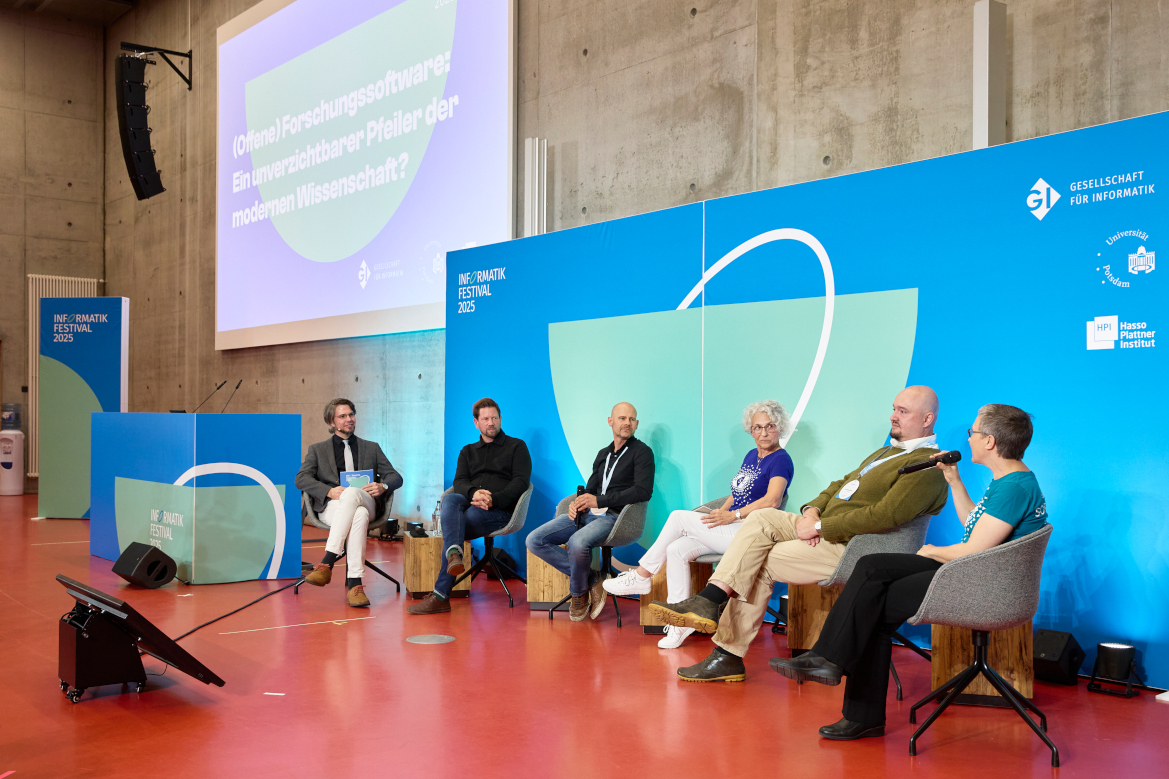
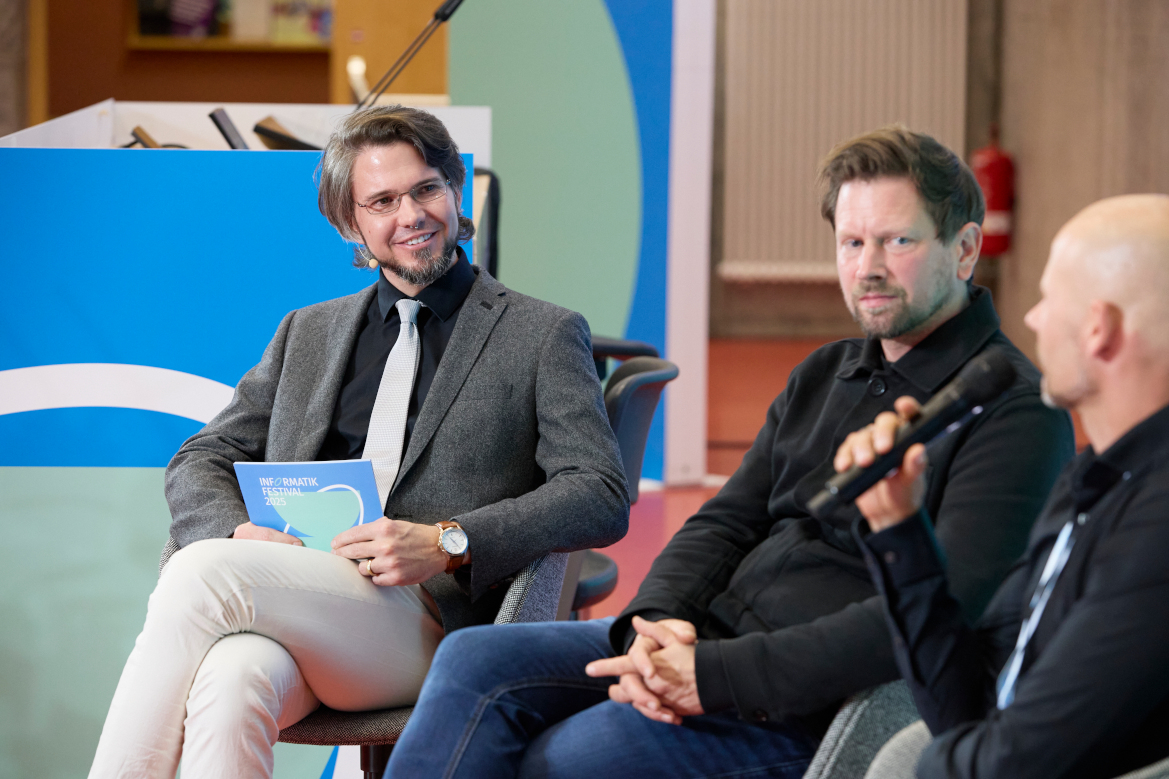
Our panel at the GI Festival 2025, moderated by Florian Mannseicher, made one thing very clear: Germany is at a turning point in the development of its research software landscape.
There is plenty of expertise, energy and motivation – yet structures, competencies and national coordination are still missing. To ensure that research software receives the same recognition as research data, we need shared frameworks and long-term strategies.
1. Openness is consensus – but not yet the standard
There was broad agreement in the discussion: openness (“as open as possible”) is the right path forward. However, open source is still far from being the norm in everyday research practice. Many researchers are unsure about licensing or fear making mistakes. In some cases, software cannot be made openly available for security or misuse-related reasons. Moreover, FAIR and open source are often conflated – FAIR does not automatically mean open, but defines minimum criteria for findability, accessibility and reusability.
In short: Openness remains the goal, FAIR the baseline – but widespread adoption requires institutional support and clear guidance.
2. Sustainability remains a blind spot
A second key point: research software is still predominantly developed within time-limited projects – and often disappears into the maintenance gap afterwards. The consequences are familiar: results become less reproducible, software ages quickly, researchers invest time without recognition, and institutions struggle with long-term maintenance.
The panel therefore called for long-term measures – such as software lifetime plans similar to research data, permanent RSE positions and clear evaluation criteria that recognise software as scientific output. Software requires care – and care requires long-term structures.
3. Infrastructure – more than GitHub
It also became clear that while GitHub is convenient, it is not a sustainable home for national research assets. Instead, we need independent, long-term stable infrastructure, such as institutional or national GitLab instances and European repositories. Connecting to Software Heritage could help archive software as part of the scientific record. Strengthening links with initiatives within NFDI and EOSC was also emphasised.
4. Early career researchers carry the load
Today, much of research software is developed and maintained by early career researchers. Alongside research obligations, they are expected to document, licence, review and sustain software – tasks that should not rest solely on individuals.
The panel was unanimous: responsibility lies in the wrong place. Without advisory structures, technical support and clear allocation of responsibilities, sustainability remains a matter of luck – and individual motivation can never replace a system.
5. Political momentum – now we need structure
Political awareness of the topic is growing. The BMFTR signaled clearly that research software is now on the agenda, and the recently published ORT Study has created positive momentum. Now, this momentum needs to be strategically converted into action.
What is required is a combination of bottom-up community engagement and top-down policymaking. Germany can learn from Open Access and Open Data: early structures accelerate change.
A. Building a national research software institution – what should happen next
1. A nationwide “Research Software Guideline”
A shared guideline could define recommended licences, clarify the role of GitHub/GitLab and provide templates for software lifetime plans. This would allow institutions to build on established standards instead of starting from scratch.
2. A Research Software Office as a central hub
Rather than building all services internally, the Research Software Office should make existing initiatives visible, connect and consolidate them, acting collaboratively rather than in parallel. It should serve as a national access point – for questions regarding licensing and FAIR practices, code review, infrastructure decisions, training opportunities, templates and best practices. By linking local RSE teams, a more coherent ecosystem can emerge. The goal is central orientation for researchers – a hub, not a replacement for existing services.
3. Strengthening sustainable alternatives to GitHub
The panel proposed evaluating a national GitLab instance and requiring funded software to be archived in Software Heritage. Coordination with NFDI and European platforms like EOSC could support long-term digital sovereignty.
4. Creating permanent positions and role profiles
Project-based positions are one of the biggest obstacles to sustainable software maintenance. Science needs continuity – and software even more so. Roles such as RSE, maintainer and software librarian should be defined and institutionally anchored. Examples from Helmholtz, the UK and the Netherlands show that this is feasible and impactful.
5. Initiating a national policy process
Next steps could include developing a 2025–2035 roadmap, hosting a national research software stakeholder conference and drafting a policy paper outlining the need for a research software institution.
B. What structures would such an institution need?
A hybrid model – community-driven and government-supported – appears promising, similar to NFDI but with a more operational component. Such an institution could build upon three pillars: advice & skills development, infrastructure & services and quality assurance & sustainability, including reviews, archiving and lifetime plans.
Equally important is the integration of existing actors such as de-RSE, GI, Helmholtz and NFDI consortia, as well as international partners like SSI and the NL eScience Center. Central will be long-term funding and a direct interface to BMFTR or other relevant ministries to connect expertise with policy decisions.
Conclusion
The panel made one thing clear: Germany is ready for a national structure for research software.
FutuRSI can help drive this process – by establishing standards, shaping infrastructure concepts, connecting community and policymakers and developing long-term strategies.
The community is motivated, policymakers are receptive, and the need is clear.
Now is the right moment to lay the foundations for a research software institution – modern, impact-oriented and aligned with the needs of researchers.